 To
maintain my PMP qualifications, I need to ensure that I continue to maintain
consistent learning with regard to Project Management. I like the idea that people cannot pass the
PMI exams and then forget about keeping up to date with learning and modern
practices.
To
maintain my PMP qualifications, I need to ensure that I continue to maintain
consistent learning with regard to Project Management. I like the idea that people cannot pass the
PMI exams and then forget about keeping up to date with learning and modern
practices.Monday, 17 February 2014
My PDU Plan
To
maintain my PMP qualifications, I need to ensure that I continue to maintain
consistent learning with regard to Project Management. I like the idea that people cannot pass the
PMI exams and then forget about keeping up to date with learning and modern
practices.

Thursday, 13 February 2014
Why Education is Important
 As a
consultant, I do not have an official career path, nor an HR department to
provide a yearly development plan. I
have to make my own development plan and think about where my career will take
me in the future. To obtain a career
path, it is down to me, what I do and how I do it.
As a
consultant, I do not have an official career path, nor an HR department to
provide a yearly development plan. I
have to make my own development plan and think about where my career will take
me in the future. To obtain a career
path, it is down to me, what I do and how I do it.
As a
consultant, any time and money spent on education and qualifications, comes out
of my time and my money, sometimes at the additional "cost" of not
being able to work for a client, earning my daily rate. The qualifications are quite expensive, often
in excess of £1000. In addition, I do
not get given any paid time by my clients to study, as I would if I was
employed.
Monday, 9 December 2013
Project Time
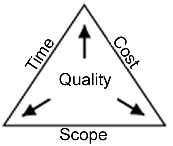 Time is part of the Project Management Golden Triangle. I have blogged
about the Golden Triangle before, but the concept is that you have Time, Scope
and Quality, as three sides to a triangle and they all impact each other. If you extend one side of the triangle, one
or both of the other two sides will be impacted.
Time is part of the Project Management Golden Triangle. I have blogged
about the Golden Triangle before, but the concept is that you have Time, Scope
and Quality, as three sides to a triangle and they all impact each other. If you extend one side of the triangle, one
or both of the other two sides will be impacted.
Time is an important aspect of Project Management. People who understand scheduling will understand
how simple and how complicated time planning can be. On larger projects, the project plan will be
controlling many different work streams in parallel and the Project Manager
needs to understand the impact of time on each of the work streams and
resources.
Agile Methodology
 As I mentioned in a post last week, I have consulting at a
client site that uses an Agile Project Management Methodology. As a Project Manager, I had thought that I
have not used Agile before, however, I now understand that as a Project Manager
/ Developer for many years, I have previously been using an Agile methodology.
As I mentioned in a post last week, I have consulting at a
client site that uses an Agile Project Management Methodology. As a Project Manager, I had thought that I
have not used Agile before, however, I now understand that as a Project Manager
/ Developer for many years, I have previously been using an Agile methodology.
In my very first job, after leaving university, I was coding
a 4GL, and our Project Management Methodology was DSDM (Dynamic Systems
Development Methodology). I went on a
course and actually became a DSDM Practitioner.
This was back in 1997.
Thursday, 5 December 2013
Introduction to Change
 Part of the overall project governance is the Change
Control. This can refer to changes in
the scope of the project, the budget, the Schedule, the services provided or
the products the project produces.
Change control needs to be in place to ensure that the project is
delivered on time, to budget and delivers the required product. Change control ensure that any change
introduced to the project is defined.
Part of the overall project governance is the Change
Control. This can refer to changes in
the scope of the project, the budget, the Schedule, the services provided or
the products the project produces.
Change control needs to be in place to ensure that the project is
delivered on time, to budget and delivers the required product. Change control ensure that any change
introduced to the project is defined.Friday, 6 September 2013
Excel - Add a Month
 I use MS Excel extensively in my day to day role. Sometimes the simplest formula can stump me, but when I find a solution, I try to capture it and add it to this blog.
This formula will take a date (say 1st Oct 2013) and then add one month to it.
=DATE(YEAR(A1),MONTH(A1)+1,DAY(A1))
Simple.
Wednesday, 3 April 2013
Can two Project Managers work on the same project?

I think they can, as long as the relationship is clear and the roles and responsibilities are defined from day one. Management above the project must buy-in to the concept of having two project managers and must agree to the defined R&R.
I am working on a large project. Within 6 months, working on the initial concepts, designs and plans in the initiation stage of the project, I realized that there was too much coordination, communication, vendor management, internal team management, user management and reporting required for a single Project Manager. I needed help and I was not afraid to ask.
We now have two Project Managers on the project and it is working really well. I am an easy person to build a relationship with. I will trust and accept any person, until they cross me or my team. The new Project Manager has a wealth of experience and is a great asset to the Project.
People within the Project Management Department often comment that there are two Project Managers working on the single project, but I see no issue with it. Slowly, the colperets are coming around to understanding that the Project has a requirement for two Project Managers to work in tandem together to be able to achieve the final delivery in the manner that the corporation requires.
Usually a Programme will have many Project Managers, but usually a project will only have one, however, due to the size and structure of the project, this project warrants the use of two project managers.
Defining the roles and responsibilities between us was an important "first day" task. Over the past year, I had built relationships with vendors, internal technical team, management and the business. The one part (and important part) of the Project Management I failed to keep on top of was the reporting. My direction as a Project Manager is to "get the job done", so I did. I covered all bases, ensuring that we had the best options, decided on the best solutions, worked with the best people and built relationships to ensure we obtained the best deals for the company I am working for. This was all to the detriment of the reporting side and the management of the stakeholders. A bad mistake.
The other Project Manager will take care of all of the governance and the management reporting side of the project, leaving me to run with the vendor engagement and the management of the technical teams to deliver the product. I am a Project Manager that focuses on the delivery rather than the Project status updates and the "Project Management" side.
Have you ever worked on a single project, with another project manager? What was your experience, what worked and what didn't?
Subscribe to:
Posts (Atom)